
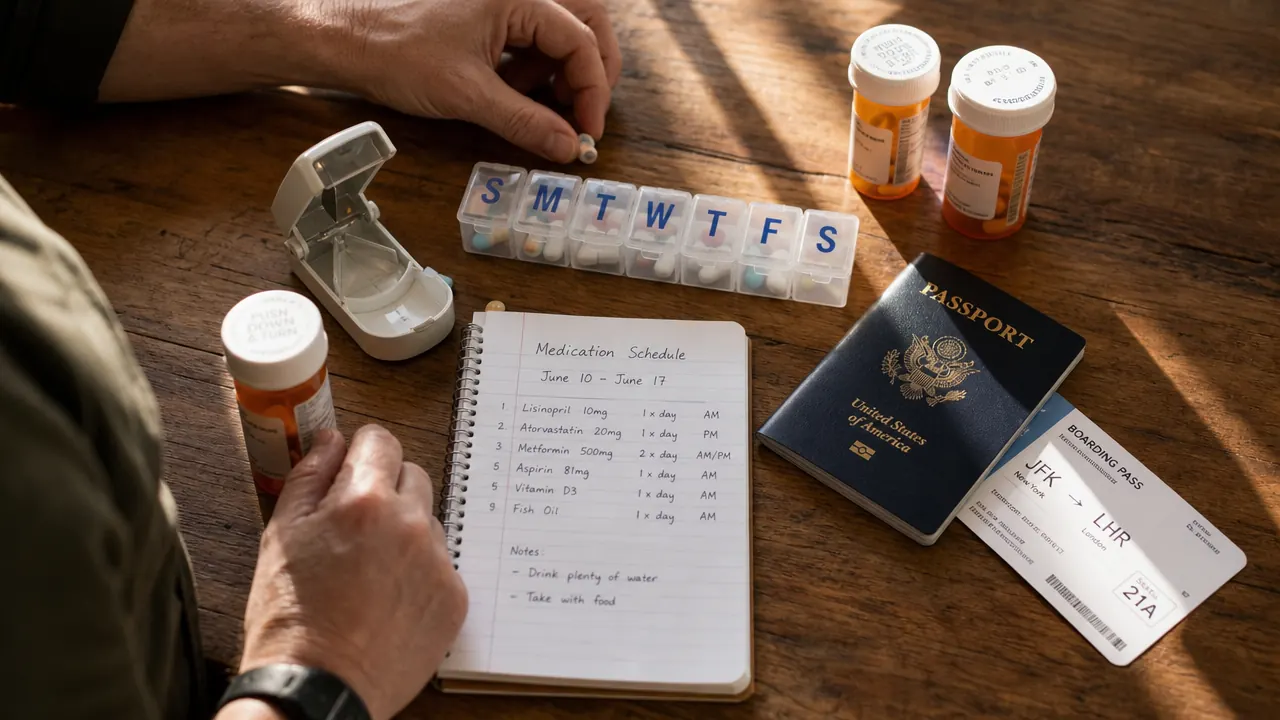
I have been on the road more or less continuously since I walked away from a desk job at 57, and I have made every medication mistake you can make. I have shown up to a Thai pharmacy at midnight looking for a blood pressure refill because I left my bottles at home. I have had a customs officer in Morocco dump every loose pill out of a Ziploc bag and ask me to explain each one. I have sweated through a 90-degree layover in Manila watching a weekly pill organizer pop open and scatter a month of metformin across the bottom of my carry-on. Each of those problems had a simple fix I just had not bothered to set up yet.
If you take anything daily, whether that is a blood pressure medication, a thyroid pill, a handful of vitamins, or a cocktail of prescriptions, travel without a real system is a gamble you will eventually lose. The good news is that getting organized takes about 30 minutes once and then pays off for every trip after. This guide walks through the exact process I use now, what TSA actually allows, what international customs officers look for, and the one piece of gear that holds the whole thing together.
If you are still packing pills loose or rattling around in the original bottles, this organizer fixes that today.
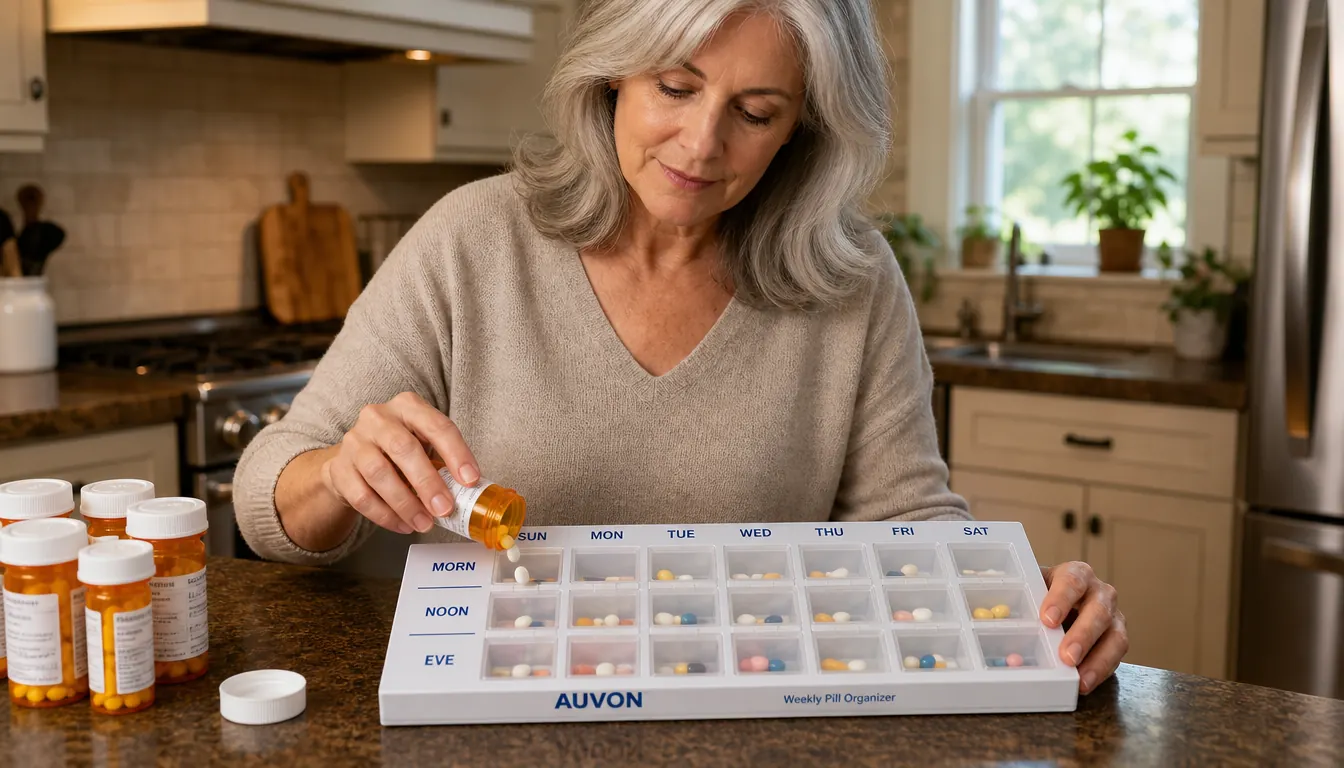
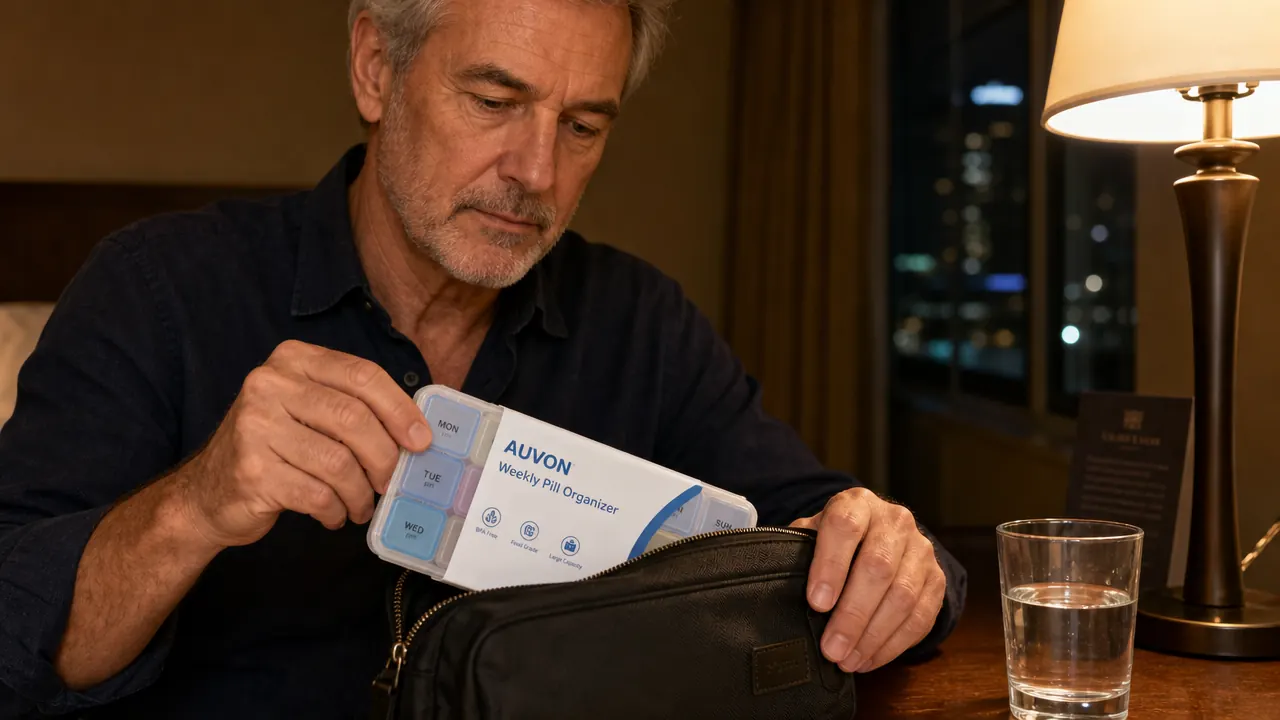
The AUVON 7-day, 3-times-daily pill organizer has a moisture-proof seal, large labeled compartments, and a 4.8-star rating across more than 22,000 reviews. It is the one I use every trip.
Amazon Check Today's Price on Amazon →Step 1: Audit Every Medication You Take and Build a Master List
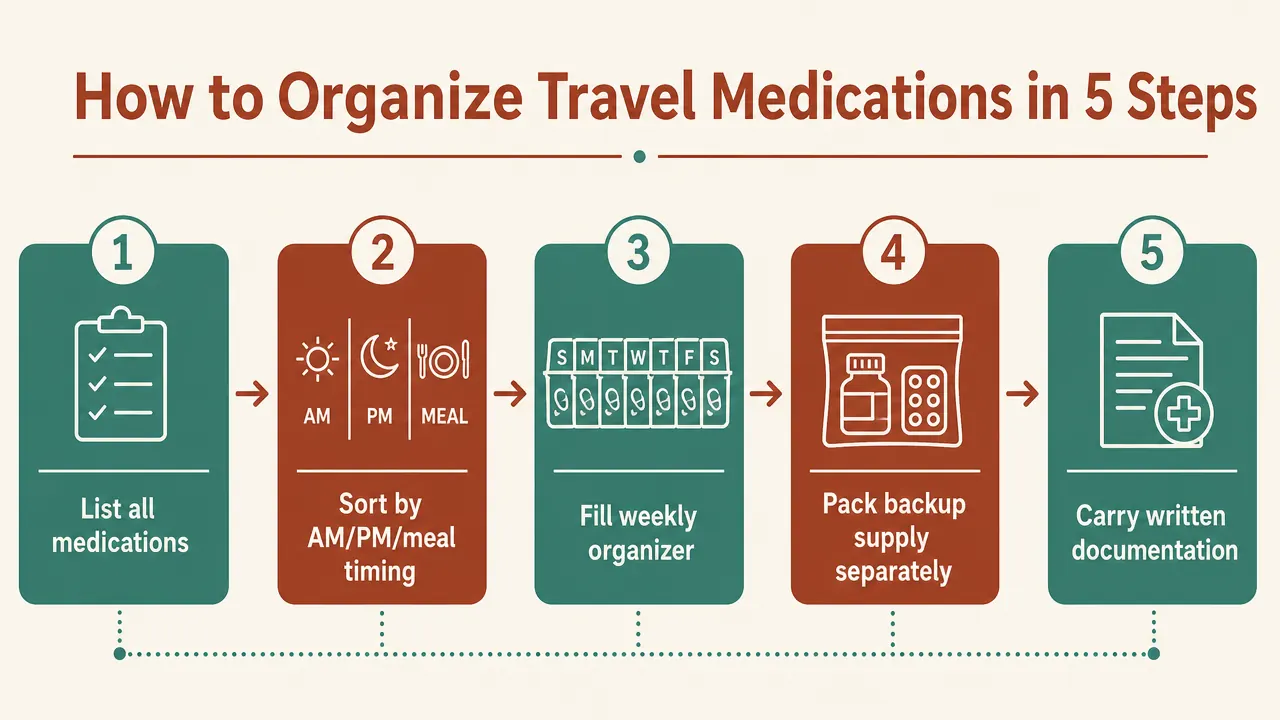
Before you touch a pill bottle, sit down and write out every single thing you swallow on a regular basis. Prescriptions, over-the-counter drugs, vitamins, herbal supplements, sleep aids, everything. For each item note the generic name (not just the brand), the dosage, the frequency, and whether it requires refrigeration or special handling. This master list becomes your documentation, your reorder reference, and your customs declaration cheat sheet.
For prescriptions specifically, ask your doctor for a signed letter that includes the drug name, dosage, prescribing physician contact, and your diagnosis. This is not paranoia. Some countries, especially in Southeast Asia, the Middle East, and parts of South America, flag certain medications at the border, including common items like strong pain relievers, some ADHD medications, and even certain antibiotics. The letter costs you nothing and takes five minutes to request. I carry mine in a folder with my passport.
While you are auditing, calculate how many doses you actually need for the trip and then add a 20 percent buffer. Flights get delayed. Trips extend. A week-long trip to Portugal can turn into ten days when a cheap flight home presents itself. Running short on a daily medication in a foreign country is stressful in ways a little extra weight in your bag is not.
Step 2: Understand What TSA Actually Allows
TSA rules on medications are more permissive than most people assume, but you still need to understand them clearly. Prescription medications in pill or solid form are allowed through security in unlimited quantities as long as they are screened. Liquid medications, including insulin and other injectables, are allowed in quantities greater than 3.4 oz, but you must declare them separately at the checkpoint. According to the TSA website, you do not need to keep medications in their original pharmacy bottles at the domestic level, though individual states and many countries have their own rules about original labeling, so check before you travel internationally.
The TSA rule that catches people is the liquid one. A 4 oz bottle of liquid ibuprofen or a large bottle of cough syrup cannot go in your quart bag alongside your shampoo if it exceeds 3.4 oz. Declare it separately. Insulin, eye drops prescribed by a doctor, and liquid vitamins all fall into the medical exemption category. Always tell the officer before the bag goes through the scanner. The process is routine and fast when you are upfront about it.
One rule that is non-negotiable: keep all medications in your carry-on bag, never in checked luggage. Cargo holds are not temperature-controlled consistently. Your bag can sit on a tarmac in Phoenix in July for 90 minutes at temperatures that degrade heat-sensitive medications. More importantly, checked luggage gets lost. Losing your suitcase is annoying. Losing a week of heart medication is a medical problem. Airlines have no obligation to replace medications lost with your bag, and most travel insurance policies require the bag to be delayed more than 24 hours before covering even basic expenses.
Step 3: Sort Your Medications Into the Right Organizer
The organizer you choose makes or breaks the whole system. I have gone through a lot of them over the years, from cheap plastic weekly boxes that snapped open at the worst moments to elaborate multi-pouch systems that took longer to pack than to use. What I landed on is the AUVON 7-day, 3-times-daily organizer. Seven columns for the days, three rows for morning, midday, and evening doses. The compartments are large enough for bigger capsules, the lids click shut firmly, and the whole thing fits in the side pocket of any carry-on.
The moisture-proof design matters more than you would think if you have not traveled through humid climates. Thailand in April, coastal Colombia year-round, and Florida in August will all introduce real humidity into your bag. Standard pill organizers let moisture in slowly and certain medications, especially ones that already absorb water easily, will stick together or degrade. The AUVON's tight-sealing compartment lids address this directly. I have carried mine through 10 days in Southeast Asia without a single pill showing any moisture damage.
When loading the organizer, do it at home before the trip, never at the gate. Sunday evening before a Monday departure works well. Go through your master list, count each dose, fill each compartment, and double-check the count for any medication where missing a dose has real consequences. Keep the original prescription bottles in a small bag alongside the organizer for the first trip to a new country so you have them if customs asks. Once you are confident in the routine, you can leave the empties at home.
Step 4: Handle Customs and International Entry the Right Way
Most countries have no interest in your vitamins and standard OTC medications. Where things get complicated is with controlled substances and medications that contain ingredients banned or restricted in that country. Japan is strict about certain decongestants containing pseudoephedrine. Indonesia is serious about narcotics and some sleep aids. The UAE restricts codeine, tramadol, and several other pain medications. Before every international trip, check the destination country's customs authority website or the U.S. Embassy country-specific page for current medication import rules. These restrictions change, so do not rely on something you read two years ago.
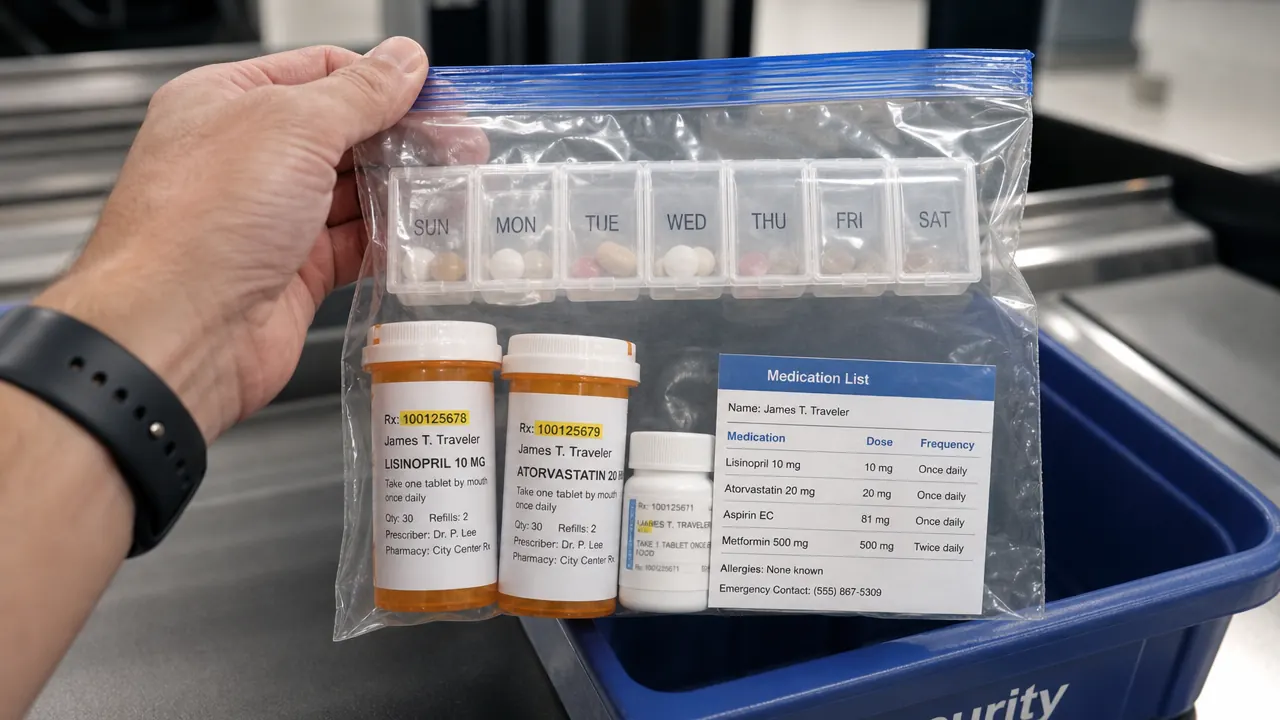
For any trip longer than 30 days, or any destination with known restrictions, carry a copy of the original prescription, not just the pill organizer. Some countries will want to see original packaging with the pharmacy label, so consider keeping one bottle intact even if you transfer the rest to the organizer. For controlled substances, carry the physician letter mentioned in Step 1 along with a translated version if you are heading somewhere that does not conduct customs business in English.
Customs declarations are where travelers make avoidable mistakes. Most customs forms ask whether you are carrying medications. Say yes and be straightforward. Officers move quickly through routine declarations. What they slow down for is inconsistency, meaning someone who says no and then has a bag full of pill bottles. Honesty is always faster.
Step 5: Build a Backup Plan Before You Leave
Every organized traveler I know who takes daily medications has some version of a backup plan. Mine has three components. First, I carry a photo of every prescription label saved in a dedicated folder on my phone and in cloud storage. If I lose the physical bottles, I have the information I need to get a local refill or at least explain the situation to a doctor. Second, for critical medications I cannot safely skip, I carry a small emergency supply in a separate bag from the main organizer, usually tucked into a toiletry kit. Not a full duplicate, just enough for 3 to 4 days.
Third, before leaving home I research the pharmacy situation at my destination. Most urban centers globally have Western-style pharmacies where common medications are available, sometimes cheaper than at home. Knowing which chain is reliable in the country I am visiting, and looking up how to ask for a medication by its generic name, is a 10-minute prep task that has saved me twice in places where the brand name meant nothing to the pharmacist.
The backup plan also covers the organizer itself. The AUVON is durable and I have not broken one yet, but I carry the original product packaging or a small Ziploc as a backup containment method. If a compartment hinge ever did fail, I want to be able to contain loose pills, not have them rolling around my bag.
What Else Helps
Beyond the organizer and the documentation, a few habits make the whole system work more smoothly. Set alarms on your phone for each dose time and adjust them to the local time zone as soon as you land, not two days in after you have already skipped a midday dose. Use the Notes app or a travel journal to log whether you took each day's doses during any trip where jet lag or a packed itinerary might cause you to lose track. For medications that require food, pack a few plain crackers in your carry-on so you are not hunting for breakfast at 6 a.m. just to take a pill safely. Small details like these are where a system either holds together or falls apart on the road.
If any of your medications require refrigeration, the conversation with your airline matters before you board. Most major carriers will store insulin and similar refrigerated medications in the galley cooler on request, but you need to ask at check-in, not at the gate. For shorter flights where you can manage without refrigeration, an insulated medication travel case with a gel ice pack buys you 6 to 8 hours safely. Check with your prescribing physician about the specific temperature tolerance of your medication before relying on that window. For insulin specifically, the ADA guidance notes that most unopened vials stay stable at room temperature for up to 28 days, but that window shortens once opened.
One last thing worth mentioning: tell a travel companion or a trusted contact at home exactly what medications you take, where you keep them, and what to do if something goes wrong. This is not morbid, it is practical. If you are incapacitated in a foreign hospital, the staff cannot help you effectively if they do not know what you take. A simple note in your phone's lock screen emergency contacts section, or a card in your wallet listing your medications and emergency contact, takes two minutes and could matter enormously.
The best medication system is the one simple enough that you actually follow it at 5 a.m. in an airport, half asleep, running on your third coffee of the morning.
You have the system. Now you need the organizer that actually holds up to it.
The AUVON 7-day, 3-times-daily pill organizer is moisture-proof, TSA carry-on friendly, rated 4.8 stars by more than 22,000 travelers, and sized to fit in the side pocket of any carry-on. There is no reason to keep improvising with Ziploc bags and loose bottles.
Amazon Check Today's Price on Amazon →