

I have bought nine travel umbrellas in the past twelve years. Four of them lasted less than one trip. Two flipped inside-out before I even left the airport taxi lane. One disintegrated in a Lisbon squall within forty minutes of purchase. The remaining three all share the same characteristics, and none of those characteristics have anything to do with price, brand name, or color. If you are buying a travel umbrella right now and you do not know what rib count, vented canopy design, and folded length mean in practical terms, you are going to repeat my mistakes. This guide is how you avoid them.
The problem with most travel umbrellas is that they are optimized for looking small on a retail shelf, not for surviving the conditions you actually travel in. Wind gusts along a waterfront in Seattle, sideways rain in Dublin, monsoon bursts in Bangkok. A cheap eight-dollar umbrella from an airport kiosk does fine in a light shower. Put it in a real wind and the canopy inverts, the ribs snap at the joint, and you are suddenly carrying a broken flower arrangement down a wet street. Here is how to read past the marketing and pick one that actually works.
Already know what you need? Here is the compact windproof umbrella I carry on every trip.
The SY COMPACT has eight fiberglass ribs, auto-open and auto-close in one button, and a folded length that fits in a jacket pocket or exterior bag pocket. Over 40,000 reviews. Worth a look before you read any further.
Amazon Check Today's Price on Amazon →Step 1: Decide Your Priority Between Size and Coverage
Every travel umbrella forces a tradeoff between folded size and canopy coverage. A compact umbrella that fits in a jacket pocket typically opens to a canopy diameter of about 38 to 40 inches. That covers one person in a moderate shower, but you are catching drops on the shoulder if the wind picks up any angle. A mid-size compact, folded to about eleven inches, opens to 42 to 44 inches and covers you properly in most real-rain conditions. Anything marketed as a 'golf' umbrella opens to 60 inches or more and is useless as a carry-on travel tool.
My rule: if I am packing for a trip where rain is a real possibility and not just a backup plan, I carry the mid-size compact. If I am doing a dry-climate trip and just want something along for emergencies, the jacket-pocket size is fine. Where most people go wrong is buying the smallest possible umbrella to save bag space and then being frustrated when it barely covers their head in an actual downpour. Know your trip conditions before you size down.
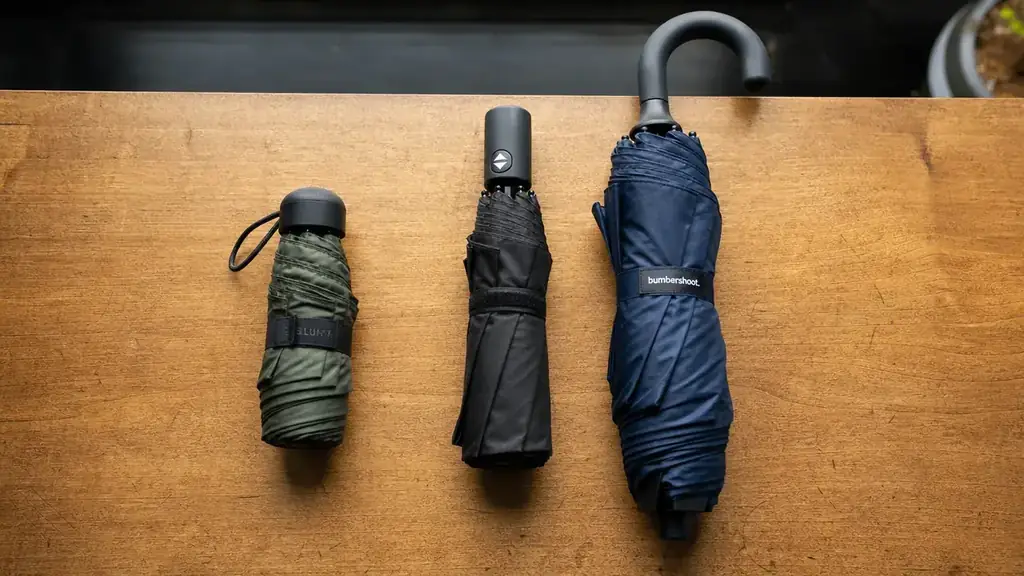
Folded length is the real carry-on spec that matters. Anything under twelve inches fits in a side pocket of a standard carry-on without sticking out past the zipper. Eleven inches is the sweet spot. Above fourteen inches and you are usually looking at a two-fold umbrella rather than a three-fold, which means less compact when open and harder to stuff into a side pocket on the go.

Step 2: Count the Ribs and Check What They Are Made Of
Rib count is the single most important structural spec on a travel umbrella. A six-rib umbrella has six narrow panels and six points of stress. Those stress points are where the canopy tears and where the ribs snap in wind. An eight-rib umbrella distributes the same forces across eight points, each panel is shorter and narrower, and the whole structure is dramatically more resistant to inversion. Go below eight ribs on any umbrella you plan to use in real weather and you are buying trouble.
Material matters as much as count. Steel ribs are cheap and heavy. Aluminum ribs are lighter but flex poorly and crack under repeated stress. Fiberglass ribs are what you want. They are light, they flex rather than snap under wind load, and they spring back to position when the gust passes. A vented double canopy, where a small layer of fabric sits above the main canopy with a gap between them, lets wind pressure escape upward instead of inverting the whole structure. If you travel in coastal cities, mountain towns, or anywhere with actual weather, look for both fiberglass ribs and a vented or windproof-rated design.
One more structural note: check whether the ribs attach to the main shaft at a reinforced collar or at a bare plastic joint. Bare plastic joints are where cheap umbrellas fail first. They crack in cold weather and shear off under side-load from wind. A metal collar or a thick reinforced hub is worth looking for in the product photos before you buy.
Eight fiberglass ribs is not a luxury spec. It is the minimum threshold for an umbrella that survives actual wind, not just light rain on a calm afternoon.
Step 3: Understand Auto-Open, Auto-Close, and Why It Matters in Transit
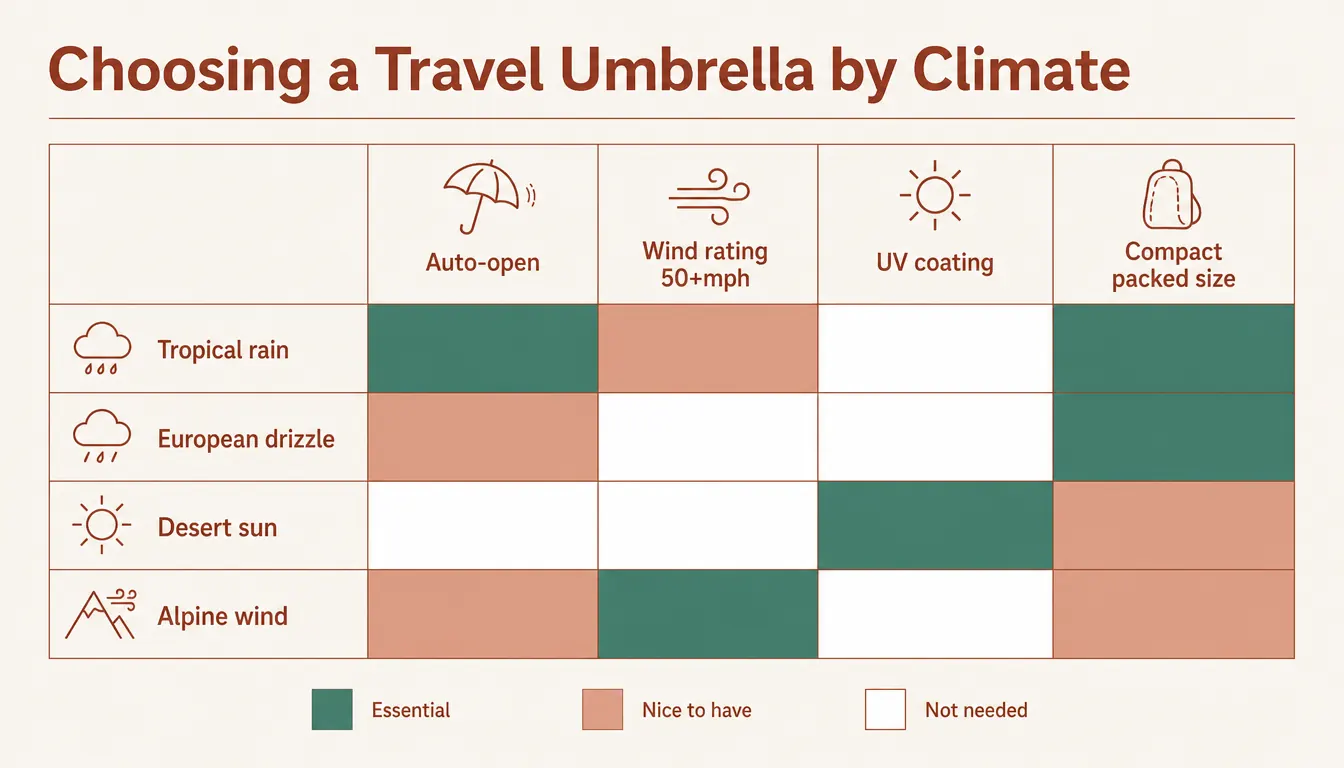
Auto-open umbrellas deploy with a button press. That sounds minor until you are managing a rolling suitcase, a shoulder bag, and a coffee in one hand while it starts raining on a departure-level curb. One-button deploy is a real convenience, not a gimmick. Auto-close, where a second button press collapses the canopy without you manually pushing down the runner, is equally useful when ducking into a doorway with wet hands.
The tradeoff with auto-open mechanisms is that they add a small amount of weight and a mechanical component that can wear out over years of heavy use. If you are an occasional traveler, this is not a concern. If you use your umbrella daily, the spring mechanism in cheaper auto-open umbrellas starts to feel weak or sluggish after a couple of years. Better-built ones use a stronger spring and a stainless button mechanism. You usually cannot tell from the listing photos alone, which is why reading reviews for comments about 'after a year of use' is more useful than the product description.
Manual umbrellas are lighter and have fewer failure points, but they require two hands to open cleanly. If you travel with both hands routinely occupied, manual is the wrong call. I carry auto-open exclusively at this point. The weight penalty is a few grams and the convenience is worth it every single time it rains.
Step 4: Check the Handle and Grip Material Before You Commit
Most people read the spec sheet and skip straight to the canopy stats. Do not ignore the handle. You are gripping this thing for extended periods in cold, wet conditions. A straight rubber-coated handle is comfortable in light use but gets slippery when wet. A textured J-curve or ergonomic grip handle gives you purchase without having to white-knuckle it to keep the umbrella from torquing in wind. A wrist strap attachment point is worth having on windy days when a gust can pull the handle out of your hand and send the umbrella into traffic.
Handle length also affects how well the umbrella vents over a shoulder bag. A longer handle lets you hold the umbrella slightly forward and to the side without covering your own face. Most compact travel umbrellas have handles in the 6-to-7-inch range, which is adequate. Under six inches starts to feel cramped for anyone with large hands, especially when wearing gloves in cold weather.
Weight is the last handle consideration. I want an umbrella under thirteen ounces. Above that and a full day of carry-on travel with the umbrella in an exterior pocket starts to list the bag noticeably to one side. The SY COMPACT comes in around twelve ounces fully assembled, which is close to the right threshold. Lighter is better, as long as it is not being achieved by thinning the rib material.

Step 5: Match the Umbrella to Your Specific Travel Pattern
Not every trip needs the same umbrella. If I am sailing or riding my motorcycle in shoulder-season weather, I want the most wind-resistant windproof-rated umbrella I can find and I am not worried about it fitting in a jacket pocket. If I am doing a two-week carry-on-only trip through Southern Europe in summer, I want the smallest and lightest option because I might not use it at all. The mistake is buying one umbrella and trying to use it as the answer for every climate.
For most travelers who want one umbrella that covers the widest range of conditions, the right answer is a three-fold compact in the eleven-to-twelve-inch range with eight fiberglass ribs, auto-open and auto-close, and a windproof-rated canopy. That covers 90 percent of real-world travel weather from a city shower to a coastal squall. It fits in every carry-on exterior pocket I have ever tested. It does not need to go in your checked luggage, which means you always have it with you.
Two other factors worth a quick note: sleeve quality and how the umbrella closes when wet. A sleeve that secures with a velcro tab rather than just a friction fit keeps the wet umbrella contained in your bag without dripping on everything else. And an umbrella that you can shake mostly dry in three or four snaps before collapsing is far preferable to one that needs to drip-dry in a corner for twenty minutes. Check the canopy fabric description. Coated polyester or pongee fabric repels water and sheds it with a good shake. Uncoated nylon holds moisture longer.
What Else Helps
Even the best travel umbrella is a single-job tool. Pair it with a waterproof outer shell or a packable rain jacket and you cover the gap between your waist and knees that no umbrella reaches in wind-driven rain. A small microfiber towel in your day bag handles the residual drips when you duck inside. And if you are traveling in monsoon conditions where rain comes at a forty-five degree angle for six hours straight, no compact umbrella is a complete solution. Know when the umbrella is the right tool and when you need a full rain kit instead. For most urban and mixed-climate travel, a compact windproof umbrella handles the job.
If you want the full breakdown on how the SY COMPACT performs across real weather conditions after extended use, the long-term review covers the specifics in detail. For a quick summary of the top reasons a windproof compact earns its bag space, the listicle on windproof travel umbrella benefits covers ten of them with real context. Either one is a useful next read before you buy.
The SY COMPACT checks every box on this guide: eight fiberglass ribs, auto-open and close, eleven-inch folded length, windproof-rated canopy.
It has over 40,000 reviews and a 4.4 rating, and it consistently holds up in real-world wind conditions rather than falling apart on the first gusty day. If you want a compact travel umbrella that does its one job without asking you to baby it, this is the one I'd put in your bag.
Amazon Check Today's Price on Amazon →